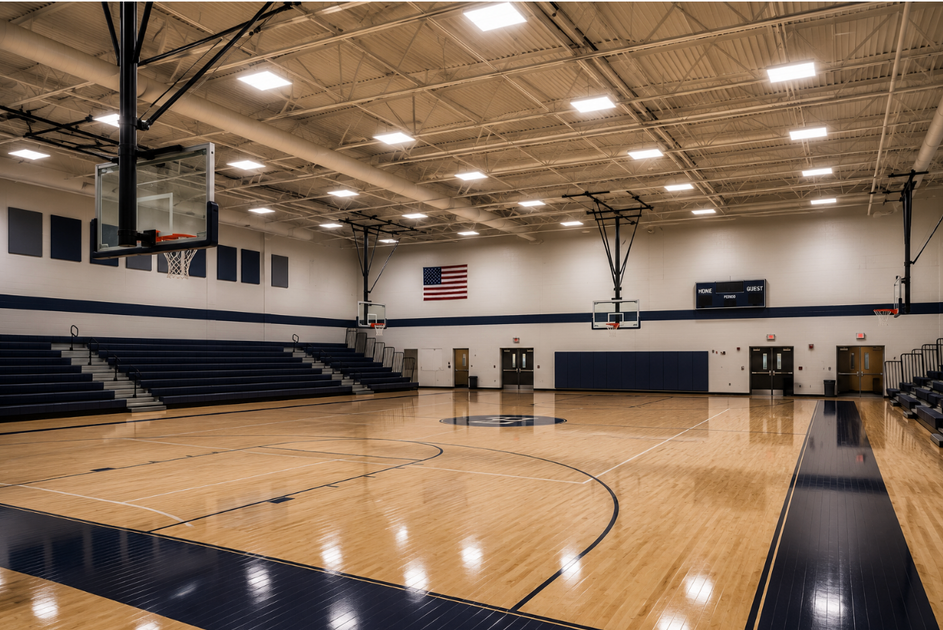
190. LED Gymnasium Lighting Done Right: Requirements, Layout & Performance
By Dani Thomason • May 25, 2026
Walk into a poorly lit gymnasium and you’ll notice it almost immediately.
The space feels dim. Shadows collect in corners. Basketballs disappear into glare overhead. Athletes strain to track movement, while spectators squint beneath uneven ceiling lights.
Now compare that to a properly designed LED gymnasium lighting system.
The difference is night and day.
The court feels brighter, cleaner, and more energetic. Visibility improves. Colors look more accurate. Players move confidently beneath balanced illumination, and facility operators benefit from lower maintenance costs and dramatically better energy efficiency.
That’s the power of smart gymnasium lighting design.
And today, with advancements in LED lighting technology, school gymnasiums, recreation centers, fitness facilities, and indoor sports complexes have far more lighting options than they did even a decade ago.
But here’s the catch: not all gym lighting systems are designed correctly.
Choosing the wrong LED fixture type, poor light distribution, incorrect mounting heights, or outdated controls can leave gymnasiums with inconsistent visibility, excessive LED glare, and unnecessary energy costs for years to come.
In this guide, we’ll break down everything facility managers, contractors, and building owners need to know about LED gym lighting, including gymnasium lighting requirements, fixture layouts, performance considerations, mounting strategies, and the best lighting solutions for high-ceiling sports facilities.
Key Takeaways
- Proper gymnasium lighting design improves visibility, athlete performance, safety, and overall energy efficiency.
- LED gymnasium lights provide longer lifespan, reduced maintenance, and lower operating costs compared to traditional lighting systems.
- Fixture selection, mounting height, beam angles, and light distribution all play a major role in gym lighting performance.
Why Gymnasium Lighting Matters More Than Many Facilities Realize
Gymnasiums are uniquely demanding environments for lighting.
Unlike standard offices or retail spaces, sports facilities involve constant movement, rapidly changing sightlines, tall ceilings, reflective flooring, and large open areas that require balanced illumination across every corner of the space.
If athletes struggle to track a volleyball against the ceiling, if glare interferes with gameplay, or if spectators notice dark spots around the perimeter, the lighting system isn’t doing its job.
Good gymnasium lighting supports:
- Athlete visibility and reaction time
- Safety during play
- Spectator comfort
- Energy efficiency
- Broadcast or recording quality
- Multi-purpose facility use
- Reduced maintenance demands
For schools, training facilities, recreation centers, and competitive sports venues, lighting directly impacts both usability and overall user experience.
Understanding Gymnasium Lighting Requirements
Before selecting fixtures, it’s important to understand the specific gymnasium lighting requirements for the space.
Different facilities require different light levels depending on how the gymnasium is used.
For example, a recreational basketball court doesn’t need the same lighting intensity as a collegiate competition venue or televised sports facility.
Several factors influence gymnasium lighting design, including:
- Ceiling height
- Court dimensions
- Type of sports played
- Multi-purpose usage
- Mounting locations
- Existing electrical infrastructure
- Reflectivity of surfaces
- Natural daylight availability
Light levels are typically measured in foot-candles, and achieving proper uniformity across the court is just as important as overall brightness.
Inconsistent lighting can create visual fatigue, shadows, and difficulty tracking fast-moving objects during gameplay.
Why LED Gymnasium Lighting Has Become the Industry Standard
Not long ago, many gymnasiums relied heavily on fluorescent lights or metal halide fixtures.
The problem? Those systems came with plenty of drawbacks.
Long warm-up times, inconsistent color quality, excessive maintenance, light flickering, and high energy consumption were all common complaints with traditional lighting systems.
Modern led gymnasium lighting solves many of those issues.
LED lights offer higher energy efficiency, better light quality, longer fixture lifespan, and improved dimming capabilities.
For commercial lighting applications, that operational efficiency adds up quickly.
Large gymnasiums often operate lighting systems for extended hours throughout the day, especially in schools, fitness centers, and community sports complexes. Reducing energy usage while improving visibility creates meaningful long-term savings.
Choosing the Right Fixtures for Gym Lighting
Fixture selection is one of the most important parts of gymnasium lighting design.
And no, there’s no one-size-fits-all answer.
The best lighting option depends heavily on ceiling height, mounting layout, facility usage, and desired performance levels.
LED High Bay Lights
For most gymnasiums with high ceiling applications, led high bay lights are the go-to solution.
These fixtures are specifically designed to provide powerful illumination from elevated mounting heights while maintaining consistent light distribution across large open spaces.
Both UFO high bay light fixtures and linear high bay light systems are commonly used in gym environments.
UFO High Bay Lights
A UFO high bay light features a compact circular design that delivers focused illumination with strong vertical output.
These fixtures are often preferred in gymnasiums with taller ceilings where concentrated downward lighting is needed.
High bay gym lights also tend to offer strong durability and long operating life.
Linear High Bay Fixtures
A linear high bay light provides broader light distribution and often creates a softer visual appearance across the court.
These fixtures work especially well in larger gymnasiums where balanced horizontal coverage is critical.
Some facilities also prefer linear light fixtures because they visually align well with court layouts and architectural designs.
Other Fixture Types Used in Gymnasiums
While high bay led lights dominate most sports facility applications, other fixtures may still play supporting roles within the overall lighting system.
For example, led ceiling panel light fixtures are sometimes used in adjacent fitness rooms, hallways, locker rooms, or office areas connected to the gymnasium.
A ceiling panel light creates soft, uniform illumination in lower-ceiling environments where high-output sports lighting isn’t necessary.
Similarly, strip light systems or tube lights may still appear in utility spaces or storage areas, though many facilities are upgrading these fixtures to more efficient led lighting alternatives.
Some premium gymnasiums also incorporate cylinder pendant lighting for architectural appeal in lobby spaces or fitness studios.
Light Distribution Matters More Than Brightness Alone
One of the biggest mistakes in gym lighting design is focusing only on brightness.
More light doesn’t automatically mean better visibility.
In reality, proper light distribution is often more important than raw output alone.
A poorly positioned gym light can create harsh glare, uneven illumination, shadowing, and hot spots.
Good gymnasium lights should create balanced illumination across the playing surface while minimizing glare for athletes and spectators.
This becomes especially important in sports involving upward tracking movements, like basketball, volleyball, or badminton.
The goal isn’t simply to flood the gymnasium with light. The goal is controlled, comfortable visibility.
The Role of Lighting Controls in Gymnasiums
Modern led gym lighting systems increasingly rely on advanced lighting control strategies.
And frankly, they should.
Smart controls help facilities reduce energy waste while improving flexibility for different activities throughout the day.
A gymnasium may host:
- Physical education classes
- Competitive sports
- School assemblies
- Community events
- Fitness training
- Maintenance operations
Each activity benefits from different lighting levels.
With integrated lighting control systems, facilities can adjust brightness levels, activate specific zones, or create custom scenes depending on usage needs.
Occupancy sensors, dimming controls, and scheduling systems also help reduce unnecessary operating hours.
Adjustable Wattage & Flexible Performance
Many modern led luminaires now offer adjustable wattage functionality.
This feature allows facility managers to fine-tune fixture output after installation without replacing the entire lighting fixture.
That flexibility can be extremely valuable in gymnasiums where usage patterns evolve over time.
For example, a facility may initially require higher light output for competitive sports but later decide to prioritize recreational use or lower operational costs.
Adjustable wattage allows facilities to adapt without major infrastructure changes.
Gymnasium Lighting Layout Best Practices
A successful gymnasium lighting design requires more than simply selecting good fixtures.
Fixture spacing, beam angles, mounting height, and aiming positions all influence overall performance.
In most high ceiling applications, fixtures should be arranged to create overlapping coverage that minimizes shadows and dark zones across the playing surface.
Designers should also account for ceiling-mounted equipment like scoreboards, ductwork, basketball hoops, and suspended structures that could interfere with lighting patterns.
And here’s something many people overlook: glare control.
Fixtures positioned directly within athletes’ primary sightlines can become distracting during gameplay, even if overall brightness levels appear adequate.
That’s why experienced commercial lighting designers prioritize both performance and visual comfort during layout planning.
LED Gymnasium Lights vs Traditional Lighting Systems
The shift away from traditional lighting systems has accelerated rapidly in recent years.
And honestly, it’s not hard to understand why.
Older fluorescent lights and metal halide fixtures simply struggle to compete with modern led gymnasium lights in terms of efficiency, LED lifespan, and control capabilities.
Traditional systems often require frequent maintenance, produce inconsistent color rendering, and consume significantly more energy than modern led light fixtures.
LED lighting also performs far better in facilities with frequent switching cycles or occupancy-based controls.
Unlike older systems that require warm-up periods, led lights provide instant-on performance with no delay.
Outdoor Sports Lighting Considerations
Some sports facilities also require outdoor lighting for adjacent courts, parking areas, or athletic fields.
In these cases, parking lot light fixtures, stadium light systems, and other outdoor lighting solutions may need integration with the facility’s overall lighting strategy.
While indoor and outdoor sports lighting systems serve different purposes, consistency in color temperature, controls, and overall visual experience still matters.
Facilities that combine indoor gymnasiums with exterior athletic spaces often benefit from a unified commercial lighting approach.
Maintenance & Long-Term Performance
One major advantage of led gymnasium lighting is reduced maintenance.
Replacing fixtures in gymnasiums with high ceiling applications can be time-consuming, disruptive, and expensive. Lift equipment is often required, particularly in larger sports facilities.
LED systems dramatically reduce those maintenance demands thanks to their longer operational lifespan.
High-quality led gym light fixtures can often operate for tens of thousands of hours before significant lumen depreciation occurs.
That reliability helps reduce downtime while lowering long-term operational costs.
Designing the Right Lighting Solution for Your Facility
Every gymnasium is different.
A school basketball court has very different needs than a competitive volleyball arena or a multi-purpose recreation center. That’s why selecting the right lighting solution requires careful evaluation of the facility’s layout, performance goals, mounting conditions, and operational priorities.
And increasingly, facility owners are prioritizing lighting systems that support future adaptability as technology continues evolving.
Final Thoughts
When it comes to gymnasium lighting, getting the design right from the beginning makes an enormous difference.
The right led gymnasium lighting system improves visibility, supports athlete performance, reduces maintenance demands, and creates a far more comfortable environment for everyone using the facility. At the same time, modern led lighting solutions help commercial and institutional buildings significantly reduce long-term energy costs.
From led high bay lights and linear light fixtures to advanced lighting control systems and adjustable wattage technology, today’s gym lighting options offer more flexibility and performance than ever before.
But successful gymnasium lighting design isn’t just about choosing brighter fixtures. It’s about creating balanced illumination, minimizing glare, optimizing light distribution, and designing a lighting system that actually supports how the facility is used day after day.