202. A Complete Guide to Auditorium Lighting: Top LED Fixtures & Best Practices
By Dani Thomason • Sep 23, 2026
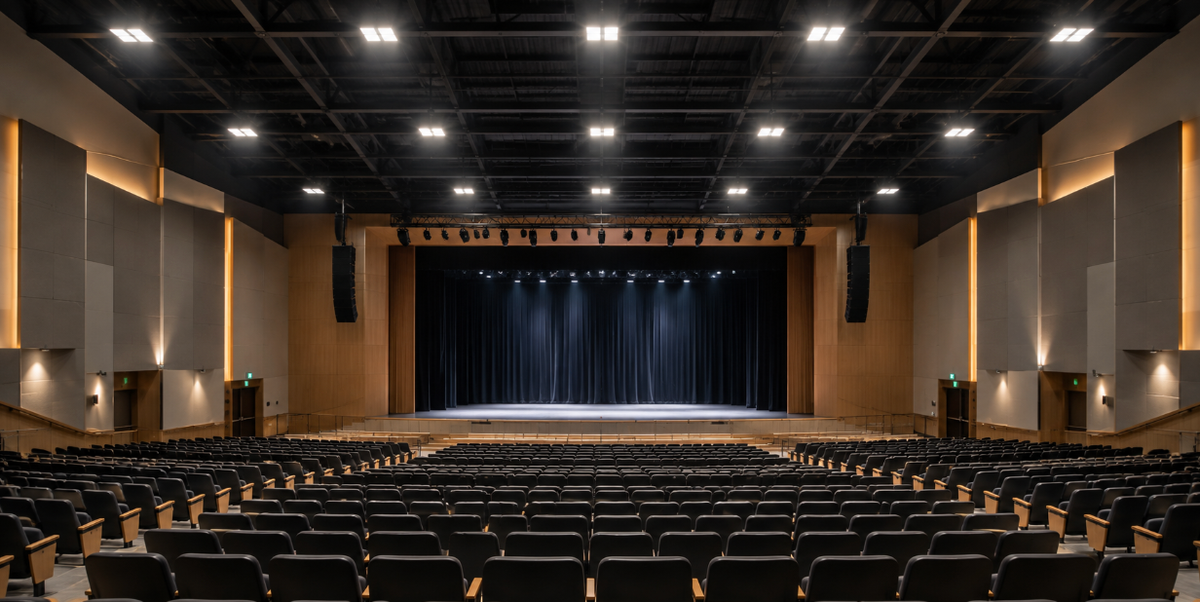
Auditoriums present a unique commercial lighting challenge. These spaces are often large, have high ceilings, fixed seating, and need enough illumination for people to safely enter, exit, find their seats, and use the space for presentations, lectures, assemblies, and other events.
Because of their ceiling height and size, many auditoriums require powerful overhead fixtures capable of distributing light effectively from elevated mounting positions. In these applications, LED high bay lighting can provide the output and coverage needed for general auditorium illumination while offering greater energy efficiency and a longer operating life than many older lighting technologies.
The key is choosing fixtures based on the auditorium's dimensions, mounting height, layout, and use. In this guide, we'll look at auditorium lighting requirements, high bay LED options, fixture placement, controls, and what to consider when upgrading an existing system.
Key Takeaways
- Auditorium lighting should provide comfortable, consistent general illumination throughout seating and circulation areas.
- Ceiling height, beam distribution, fixture output, glare, and seating layout all influence lighting performance.
- LED lighting can reduce energy and maintenance requirements compared with many older auditorium lighting technologies.
- Dimming and zoning allow facility operators to adjust general illumination for different uses of the space.
What Is Auditorium Lighting?
Auditorium lighting refers to the general illumination used throughout large assembly spaces such as school auditoriums, university lecture halls, municipal auditoriums, conference facilities, and multipurpose event spaces.
The primary goal is to provide enough light for occupants to comfortably and safely navigate the room. This includes illuminating seating areas, aisles, entrances, exits, and other general-use areas.
Many auditoriums have relatively high ceilings, which creates challenges similar to other large commercial spaces. Fixtures need to deliver sufficient illumination from elevated mounting positions while maintaining consistent coverage throughout the room.
This is where high bay LED fixtures can be particularly useful.
Why High Bay Lighting Works for Auditoriums
High bay lighting is designed for large commercial and industrial spaces with high ceilings. While commonly associated with warehouses and manufacturing facilities, high bay fixtures can also be appropriate for auditoriums, gymnasiums, convention spaces, and other large indoor environments.
The higher a fixture is mounted, the farther its light must travel before reaching the area below. That means auditorium fixtures need enough lumen output and the appropriate beam distribution to illuminate seating and circulation areas effectively.
LED high bays are available in different outputs and distributions, allowing the lighting design to account for factors such as:
- Ceiling height
- Auditorium dimensions
- Seating layout
- Fixture spacing
- Required illumination
- Beam angle and distribution
- Glare control
- Dimming requirements
Not every auditorium requires high bay lighting. Facilities with lower ceilings may be better suited to other commercial LED fixtures. However, for large auditoriums with elevated mounting heights, high bay LEDs can provide an effective solution for general overhead illumination.
Types of LED Lighting for Auditoriums
Rather than relying on one fixture throughout the entire facility, an auditorium may use several types of commercial lighting for different areas.
LED High Bay Lights
For high-ceiling auditoriums, LED high bay lights can provide the primary overhead illumination.
High bays are designed to produce significant light output from elevated mounting positions. Depending on the fixture and optical distribution, they can illuminate large areas while reducing the number of fixtures required compared with lower-output alternatives.
For an auditorium, the objective is to create relatively consistent illumination throughout seating and circulation areas without producing distracting glare or excessively bright spots.
LED Retrofit Options
Many older auditoriums still use metal halide, fluorescent, or other traditional lighting technologies. Depending on the existing fixtures, these facilities may be able to transition to LED without replacing every component of the lighting system.
LED retrofit solutions can provide an alternative to complete fixture replacement when the existing fixture housings and infrastructure are still suitable for use.
Before choosing a retrofit, facilities should evaluate the condition of existing fixtures, mounting configurations, electrical infrastructure, controls, and required light levels.
Aisle, Entrance, and Egress Lighting
High bay fixtures may provide the primary overhead illumination, but they aren't necessarily responsible for every lighting requirement in an auditorium.
Aisles, stairs, entrances, and exits may require separate fixtures to maintain adequate visibility, particularly when the primary auditorium lighting is dimmed.
Emergency lighting should also be designed according to applicable building, fire, and life-safety requirements.
Key Auditorium Lighting Requirements
A successful auditorium lighting design starts with the space itself rather than a particular fixture.
Ceiling and Mounting Height
Ceiling height is one of the most important considerations when choosing auditorium lights. Fixtures mounted at greater heights need to deliver light across a greater distance. Output, optics, beam angle, and fixture spacing therefore need to work together to deliver sufficient illumination at seating level. High ceilings also make maintenance more difficult. Changing a lamp or fixture may require lifts or specialized equipment, making fixture longevity particularly valuable.
Light Levels
There isn't one ideal light level for every auditorium. Appropriate illumination depends on the room's primary use and what occupants need to do within the space. General illumination may need to be brighter while people enter, exit, clean, or maintain the auditorium. Lower illumination may be appropriate during presentations or events. Rather than selecting fixtures based solely on wattage, the goal should be to deliver the appropriate amount of usable light to the occupied areas below.
Uniform Light Distribution
Consistent coverage is particularly important in a large auditorium. Poor fixture spacing or inappropriate beam distributions can create overly bright areas alongside noticeable dark spots. The lighting layout should instead provide relatively uniform illumination throughout the seating area and other occupied portions of the room. Fixture output, mounting height, beam angle, and spacing all affect uniformity.
Glare Control
Because auditorium fixtures may be positioned directly above or within the audience's field of view, glare is an important design consideration. Fixture optics and positioning can help keep high-output light sources from becoming distracting or uncomfortable.
Maintenance Access
Maintenance can be challenging when fixtures are installed high above fixed auditorium seating. Before selecting a fixture, consider how it will eventually be accessed for maintenance or replacement. Choosing long-life LED fixtures can help reduce how frequently lifts or other specialized equipment are required.
Auditorium Lighting Controls and Dimming
Auditoriums rarely operate at one brightness level throughout the day. Full illumination may be needed for cleaning, maintenance, meetings, or audience entry. During a presentation or event, the general house lighting may need to be reduced.
Lighting controls can allow facility operators to:
- Dim general overhead lighting
- Control different sections of the auditorium independently
- Create preset lighting levels
- Turn unused areas off
- Integrate lighting with occupancy or scheduling controls
LED fixtures can work particularly well in these applications because many are compatible with modern dimming and control systems. Fixture, driver, and control compatibility should always be verified before installation.
Choosing Color Temperature and CRI
Brightness isn't the only factor that influences how an auditorium looks and functions. Color temperature describes whether a light appears warmer or cooler and is measured in Kelvin. The appropriate color temperature will depend on the purpose and design of the facility.
Educational and multipurpose auditoriums may benefit from a neutral appearance that supports visibility, while other assembly spaces may prefer a somewhat warmer environment.
Color rendering index, or CRI, describes how accurately a light source renders colors compared with a reference source. Good color rendering can help occupants clearly see speakers, signage, finishes, architectural details, and other elements throughout the auditorium.
Benefits of LED High Bay Lighting for Auditoriums
For facilities replacing fluorescent, metal halide, or other older lighting technologies, LED high bay fixtures can offer several advantages.
Lower Energy Consumption
Large auditoriums may contain numerous high-output fixtures that operate for hours at a time. LED fixtures can deliver the necessary illumination while consuming less energy than many older technologies. Actual savings will depend on the existing system, replacement fixtures, operating hours, and lighting controls.
Reduced Maintenance
Maintenance is an especially important consideration in auditoriums because fixtures may be difficult to access. The long operating life of LEDs can reduce how frequently lamps or fixtures need to be serviced, which can be particularly valuable when accessing them requires lifts or specialized equipment.
Instant-On Performance
LED fixtures reach full output almost immediately. This gives facility managers greater flexibility to turn lighting on and off as needed instead of accounting for the warm-up or restrike times associated with some traditional lighting technologies.
Better Lighting Control
LED fixtures are available with different lumen outputs, beam distributions, color temperatures, and control capabilities. That makes it easier to select a fixture configuration suited to the auditorium's ceiling height, dimensions, and operational needs.
FAQs About Auditorium Lighting
Are high bay lights suitable for auditoriums?
They can be. LED high bay lights are particularly applicable to large auditoriums with high ceilings because they're designed to deliver substantial illumination from elevated mounting positions. The appropriate fixture depends on ceiling height, room dimensions, required light levels, and beam distribution.
Can an existing auditorium be converted to LED lighting?
In many cases, yes. Depending on the condition and compatibility of the existing fixtures, an auditorium may be able to use LED retrofit solutions instead of replacing every fixture. Existing electrical infrastructure, controls, mounting configurations, and required illumination should be evaluated first.
Is auditorium lighting the same as stage lighting?
No. General auditorium lighting illuminates seating, aisles, entrances, and other occupied areas. Stage and theatrical lighting are specialized systems designed around performances and production requirements and should be treated separately.
Upgrade Your Auditorium Lighting With OEO Energy Solutions
Auditoriums with high ceilings need lighting capable of delivering consistent illumination across a large indoor space. The right system should provide sufficient visibility while managing glare, energy consumption, maintenance requirements, and lighting controls.
Whether you're replacing outdated high bay fixtures, converting an existing system to LED, or planning lighting for a new auditorium, OEO can help identify the right solution based on your facility's mounting height, layout, and lighting requirements.
Contact OEO Energy Solutions to discuss LED high bay lighting options for your auditorium or commercial facility.