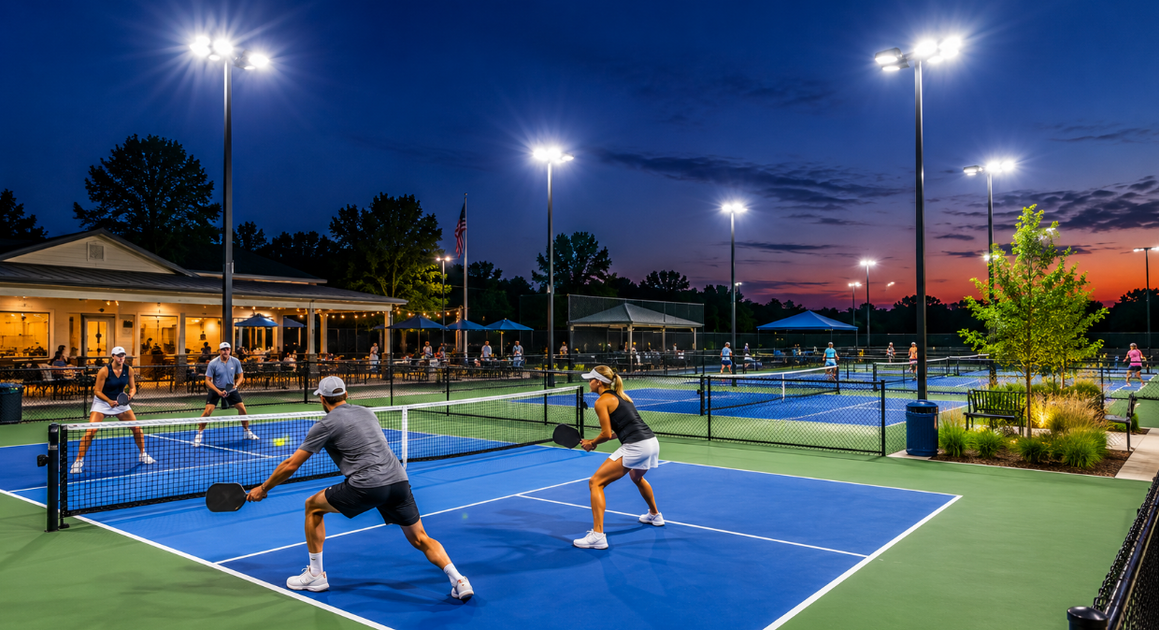
195. Pickleball Court Lights: LED Lighting Requirements & Best Practices
By Dani Thomason • Jun 25, 2026
Pickleball's rise has been nothing short of remarkable. Once viewed as a recreational pastime played primarily in retirement communities, the sport has rapidly become one of the fastest-growing activities in North America. New courts are appearing everywhere, from public parks and schools to country clubs and dedicated sports complexes. As facilities expand their offerings to meet demand, many operators are discovering that quality pickleball court lighting is just as important as the court itself.
While a court may look relatively simple compared to larger sports venues, lighting it effectively presents a unique set of challenges. Players need to track a small, fast-moving ball, often against dark skies or changing weather conditions. Poor visibility, uneven illumination, and excessive glare can quickly affect gameplay and create a frustrating experience for players no matter their skill level.
Whether you're designing a single outdoor pickleball court or planning a larger pickleball facility, investing in the right pickleball court lights can improve player safety, extend operating hours, and increase court usage throughout the year. In this guide, the experts at OEO will be exploring the lighting requirements, fixture recommendations, and design best practices that help create a professional-quality playing environment.
Key Takeaways
- LED pickleball court lights provide the best combination of visibility, energy efficiency, and long-term reliability.
- Proper fixture placement, pole height, and glare control are just as important as overall brightness.
- A professionally designed lighting system improves player experience, extends court availability, and reduces operating costs.
Understanding Pickleball Court Lighting Requirements
Unlike many recreational spaces where basic visibility is sufficient, pickleball court lighting must support fast-paced athletic activity. Players are constantly tracking movement, reacting to quick volleys, and looking upward to follow lobs and overhead shots. As a result, lighting design requires a careful balance of brightness, uniformity, and visual comfort.
The challenge isn't simply producing enough light. The goal is to provide consistent visibility across the entire court without creating harsh contrasts between bright and dark areas. Uneven court lighting can make it difficult for players to judge distance and ball trajectory, particularly during evening matches.
Lighting requirements also vary depending on how the court will be used. A neighborhood recreation court has different needs than a competitive tournament venue. Facilities that host organized leagues or sanctioned events often require higher illumination levels and tighter uniformity standards to support advanced play.
Organizations such as the USA Pickleball Association provide guidance for court design and facility planning. While exact requirements vary, most facilities aim to create an environment where players can track the ball comfortably from any position on the court.
Why LED Lights Have Become the Industry Standard
Over the past decade, LED lighting has transformed sports facilities of every size. Today, nearly all new pickleball lighting systems utilize LED technology because it offers significant advantages over traditional metal halide fixtures.
Modern LED lights consume less energy, produce higher-quality illumination, and maintain performance for far longer than older technologies. For facilities operating multiple courts, these efficiencies can lead to substantial savings over the lifetime of the system.
LED lighting also provides better visibility. The crisp, uniform light output helps players track the ball more effectively while reducing shadows across the court surface. This becomes particularly valuable during evening play, when visibility can directly influence player performance and safety.
Another major advantage is flexibility. Many modern systems can integrate with lighting controls, allowing operators to schedule operating hours, dim fixtures during slower periods, and manage multiple courts independently. These capabilities help maximize energy savings without sacrificing performance.
Pickleball Court Lights and Recommended Illumination Levels
One of the most common questions facility owners ask is how much light a pickleball court actually needs.
For recreational facilities, the focus is on providing comfortable visibility for casual play. Competitive venues, on the other hand, often require higher illumination levels to support faster gameplay and more demanding visual requirements.
However, brightness alone isn't enough. Uniformity is equally important. A court with bright hotspots and darker areas may technically meet illumination requirements while still creating a poor player experience. Effective pickleball court lighting focuses on delivering balanced visibility from baseline to baseline and sideline to sideline.
This principle extends across sports lighting applications, whether designing tennis court lighting, basketball court lighting, baseball field lighting, or larger outdoor sports lighting installations. The most successful systems prioritize consistency as much as raw light output.
Managing Glare and Visual Comfort
If there's one factor that can undermine an otherwise excellent lighting system, it's glare.
Because pickleball involves frequent upward sightlines, players often look directly toward fixtures while tracking lobs and overhead shots. Excessive glare can temporarily impair vision, affect reaction times, and create a frustrating playing experience.
Modern LED fixtures have significantly improved glare control through advanced optics and beam management. Rather than scattering light broadly, today's fixtures direct illumination precisely where it's needed. This improves visibility on the court while reducing visual discomfort for players and spectators.
Proper pole placement also plays an important role. Mounting fixtures at appropriate heights helps keep bright light sources out of a player's direct field of view. The result is a more comfortable environment that supports longer playing sessions and better overall performance.
Outdoor Pickleball Court Lighting Design Best Practices
Designing lighting for an outdoor pickleball court requires careful planning. Every aspect of the system, from fixture selection to pole placement, affects visibility, efficiency, and player comfort.
One of the most important considerations is achieving consistent illumination throughout the playing area. Unlike general outdoor lighting applications, sports facilities require highly controlled light distribution. Fixtures must provide coverage across the entire court without creating shadows, dark zones, or excessive spill light.
Pole height is another critical factor. Taller light poles typically allow designers to spread light more evenly and improve overall uniformity. They can also help reduce glare by moving fixtures farther from players' direct line of sight.
For facilities with multiple outdoor courts, lighting layouts become even more important. Designers must coordinate fixtures across the entire complex to maintain visibility while avoiding unnecessary overlap between courts. Professional photometric analysis can help optimize performance before installation begins.
Indoor Pickleball Court Lighting Considerations
Indoor pickleball court lighting presents a different set of challenges.
While weather is no longer a concern, ceiling heights, reflective surfaces, structural beams, and wall colors all influence how light behaves within the space. A lighting layout that performs well in one building may not produce the same results in another.
Maintaining uniform visibility remains the primary objective. Players should be able to track the ball comfortably without encountering harsh shadows or distracting bright spots. Some facilities incorporate indirect lighting techniques to soften contrasts and create a more comfortable visual environment.
Lighting Controls, Energy Savings, and Maintenance
Modern pickleball lighting systems do more than illuminate a court. They also help facilities improve efficiency and control operating expenses.
Advanced lighting controls allow facility managers to schedule operating hours, dim fixtures when appropriate, and activate specific courts based on demand. These features can significantly reduce energy consumption, particularly in larger facilities where usage varies throughout the day.
Maintenance savings are another major advantage of LED lighting. Traditional sports lighting systems often require regular lamp replacements and ongoing upkeep. LED fixtures are designed for long service life, helping facilities reduce maintenance costs and avoid disruptions caused by frequent repairs.
For schools, municipalities, parks departments, and private sports complexes, these long-term savings can have a meaningful impact on overall operating budgets.
Choosing the Right Lighting Fixtures and Poles
The success of any pickleball lighting system depends heavily on selecting the right equipment.
Sports-specific lighting fixtures are designed to deliver precise light distribution, helping maintain consistent illumination while reducing glare. This differs significantly from products intended for warehouse lighting or general commercial applications.
The supporting infrastructure is equally important. Light poles must be selected based on local environmental conditions, wind loads, and mounting requirements. Many facilities also incorporate specialized light pole accessories that improve durability and simplify installation.
When evaluating options, facility owners should consider long-term value rather than focusing solely on initial costs. High-quality fixtures often provide better performance, lower maintenance requirements, and improved energy efficiency throughout their lifespan.
Beyond the Court: Additional Lighting Considerations
Many pickleball facilities require more than court lighting alone. Parking areas, walkways, entrances, and gathering spaces all contribute to the overall user experience.
As a result, projects often incorporate parking lot lighting, security lighting, and landscape lighting alongside the primary court lighting system. A cohesive lighting strategy helps improve safety, create a welcoming environment, and support smooth transitions between different areas of the facility.
For larger complexes, integrating these systems under a single control platform can further improve efficiency and simplify facility management.
Frequently Asked Questions About Pickleball Court Lighting
What is the best lighting for a pickleball court?
LED lighting is the preferred choice because it provides excellent visibility, energy efficiency, long fixture life, and superior glare control.
How bright should pickleball court lights be?
Most recreational courts require 30–50 foot-candles, while competitive facilities often require 50–75 foot-candles or more.
How many lights are needed for a pickleball court?
Most outdoor pickleball courts use four to eight LED fixtures, depending on court size, pole height, and illumination goals.
How tall should pickleball court light poles be?
Most installations use poles between 20 and 35 feet tall to provide consistent coverage and reduce glare.
Can pickleball court lights reduce light pollution?
Yes. Modern LED fixtures use precision optics that focus light on the court and minimize spill light beyond the playing area.
Is pickleball court lighting different from tennis court lighting?
Yes. While the design principles are similar, pickleball courts are smaller and typically require different fixture layouts and beam distributions.
How long do LED pickleball court lights last?
Commercial-grade LED sports fixtures are commonly rated for 50,000 to 100,000 hours of operation.
Why is glare control important for pickleball courts?
Excessive glare can make it difficult for players to track the ball, particularly during lobs and overhead shots.
Final Thoughts
As pickleball continues its rapid growth, high-quality pickleball court lights are becoming an essential investment for facilities of all sizes.
The right lighting system improves visibility, enhances player safety, extends operating hours, and supports a better overall experience for both recreational and competitive players. By focusing on LED technology, proper fixture placement, glare control, and consistent illumination, facility owners can create courts that remain functional and inviting long after sunset.
At OEO Energy Solutions, our team of lighting experts helps organizations design customized outdoor sports lighting solutions that balance performance, efficiency, and long-term value. Whether you're upgrading an existing facility or planning a new installation, a well-designed lighting system can help ensure years of successful play.