201. A Complete Guide to Arena Lights: Types, Requirements & LED Options
By Dani Thomason • Sep 23, 2026
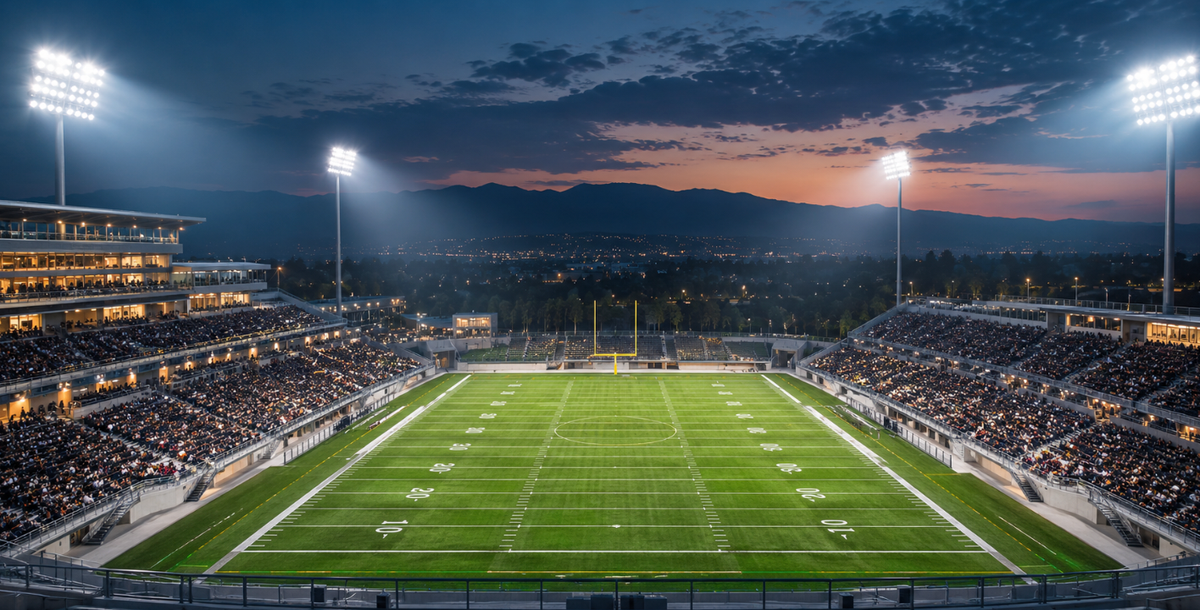
Lighting a sports arena or stadium is a balancing act. You need enough output to illuminate a large playing surface, but simply adding brighter fixtures isn't necessarily the answer. Poor placement can create glare, uneven coverage, dark spots, and wasted light, all of which can affect visibility for athletes, officials, and spectators.
That's why arena and stadium lighting projects require careful planning around factors like field or court size, mounting height, beam distribution, fixture placement, and the level of competition. An indoor basketball arena, high school football stadium, and professional soccer stadium may all require powerful lighting, but the way that light is delivered can look very different.
For many commercial, educational, and municipal sports facilities, LED arena lights have become a go-to option thanks to their high output, directional control, long operating life, and energy efficiency. In this guide, we'll cover the different types of arena lights, key lighting requirements, and what to consider before starting a sports lighting project.
Key Takeaways
- Arena and stadium lighting should provide consistent visibility across the entire playing surface.
- Lighting requirements vary based on the sport, venue size, mounting height, and competition level.
- LED stadium lights provide high output with greater energy efficiency and optical control than many older lighting technologies.
- A photometric lighting plan can help determine fixture quantity, placement, beam angles, and required light levels before installation.
What Are Arena Lights?
Arena lights are commercial lighting fixtures designed to illuminate large indoor and outdoor sports venues, including stadiums, athletic fields, gymnasiums, and multipurpose arenas. Unlike general-purpose lighting, arena fixtures typically need to distribute significant amounts of light over long distances while maintaining consistent visibility across the playing surface.
Outdoor arenas and stadiums often rely on high-output fixtures mounted on tall light poles or structural supports. Indoor arenas may use ceiling-mounted or suspended lighting systems, including high bay LED fixtures.
The goal isn't simply maximum brightness. A properly designed system should provide the appropriate illumination for the activity while accounting for factors such as beam angles, mounting height, glare, and the layout of the venue.
Where Is Arena and Stadium Lighting Used?
Arena and stadium lighting is used across a range of indoor and outdoor sports facilities, including:
- Professional and collegiate stadiums
- Football and soccer fields
- Baseball fields
- Indoor basketball arenas
- School and university athletic facilities
- Gymnasiums and indoor sports courts
- Municipal sports complexes
- Multipurpose athletic venues
Each facility has different lighting demands. A high school gymnasium won't require the same fixture output or mounting configuration as a large outdoor football stadium.
OEO offers several sports lighting solutions for these applications, including dedicated Field & Stadium Lighting for large outdoor venues and Indoor Sports Courts / Gymnasium solutions for indoor athletic facilities.
Common Types of Arena and Stadium Lights
The appropriate fixture depends largely on whether the venue is indoors or outdoors, its size, and the amount of illumination required.
LED Arena and Stadium Lights
LED arena lights are increasingly common for both new installations and lighting retrofits. They can provide the high lumen output required by large sports venues while consuming less energy than many older lighting technologies.
For large outdoor venues, LED stadium lights are typically installed on poles or structural supports surrounding the playing area. Different optical distributions can then direct illumination toward specific sections of the field.
LED Flood Lights
Commercial LED flood lights provide broad, powerful illumination and may be used for portions of the playing surface or surrounding areas such as entrances, walkways, equipment areas, and facility perimeters.
However, not every LED flood light is appropriate for arena or stadium lighting. Output, beam angle, durability, mounting height, and photometric performance all need to match the application.
High Bay Lighting for Indoor Sports Arenas
Indoor arenas, gymnasiums, and athletic facilities may use high bay LED lighting when fixtures are installed from high ceilings.
For sports applications, LED high bay fixtures should be positioned with movement, athlete sightlines, glare, shadows, and ceiling height in mind.
LED Retrofit Options for Existing Stadium Lights
Facilities still using metal halide, HID, or other older technologies may not need to replace their entire lighting system to transition to LED.
OEO's sports lighting solutions include LED retrofit lamps and kits for compatible existing fixtures. This can allow facilities to retain portions of their existing lighting infrastructure while upgrading the light source.
Whether a retrofit or complete fixture replacement makes more sense depends on the condition and compatibility of the existing equipment and the performance requirements of the facility.
Key Arena and Stadium Lighting Requirements
Choosing a fixture is only one part of the process. Arena and stadium lighting should be designed as a complete system.
Light Levels
The appropriate light level depends on how the venue is used. A recreational or high school facility generally won't have the same illumination requirements as a professional stadium hosting major competitions or televised events.
Rather than focusing on fixture wattage alone, lighting designers evaluate how much usable light reaches the playing surface.
Venue Size and Layout
Venue size directly affects fixture quantity, output, beam angles, and mounting locations. The dimensions of the playing surface are only part of the equation. Stands, scoreboards, fences, roofs, buildings, and other structures can also affect where poles and fixtures can be installed.
Uniform Light Distribution
High output doesn't automatically mean good lighting. If one section of a field is significantly brighter than another, visibility can change as athletes move across the playing area.
Fixtures should work together to provide consistent illumination while minimizing overly bright areas, dark spots, and abrupt changes in light levels.
Glare and Spill Light Control
Poorly positioned arena lights can create distracting glare for athletes, officials, and spectators. This is particularly important in sports where players frequently look upward to track a ball.
Glare control depends on fixture optics, placement, mounting height, and aiming.
A well-designed system should also limit spill light, or illumination that reaches areas outside the intended playing surface. This can be especially important for stadiums located near residential properties, businesses, or roads.
Mounting Height and Light Poles
Outdoor stadiums commonly use fixtures mounted on tall light poles surrounding the playing surface. The greater the mounting height, the farther the light needs to travel, making fixture output and optics particularly important.
Projects may also require compatible brackets, crossarms, mounting hardware, and other light pole accessories to achieve the appropriate fixture positioning.
Stadium and Arena Lighting Considerations by Sport
Different sports create different visual demands, so lighting design should account for the dimensions of the playing surface, athlete movement, ball trajectory, and competition level.
Football and Soccer Stadium Lighting
Football and soccer fields require illumination across a large playing surface and over long viewing distances.
High-output stadium lights are generally installed on multiple poles or structural supports surrounding the field. Careful aiming is particularly important because athletes frequently look upward or across the field during play.
Baseball Stadium Lighting
Baseball field lighting presents a different challenge because the playing surface isn't a simple rectangle.
The infield, outfield, bases, foul territory, and home plate all need adequate illumination. Players also need to track a relatively small ball traveling at high speeds and across long distances, making uniformity and fixture positioning especially important.
Indoor Basketball and Multipurpose Arenas
Indoor basketball arenas need clear visibility of players, the ball, court boundaries, and baskets while minimizing glare from overhead fixtures.
Smaller gymnasiums and indoor courts may use high bay sports lighting, while larger arenas may require a more customized system based on ceiling height, seating, court configuration, and competition level.
Multipurpose arenas may also benefit from lighting controls that allow operators to adjust the system for different sports or events.
Why Choose LED Arena and Stadium Lighting?
LED technology offers several advantages for large sports facilities, particularly those replacing older HID or metal halide systems.
Lower Energy and Maintenance Requirements
Large stadium systems may contain numerous high-output fixtures that operate for hours at a time. Replacing older technologies with LEDs can reduce energy consumption, depending on the existing system and replacement design.
Maintenance can also be a major consideration. Replacing fixtures installed high above a field or arena may require lifts, specialized equipment, and trained personnel. The longer lifespan of LEDs can reduce how frequently those interventions are required.
Instant-On Operation
Traditional HID stadium lighting can require time to reach full brightness and may need a restrike period after being switched off. LED fixtures reach full output almost immediately, giving facility operators greater flexibility over when and how the lighting system is used.
Better Optical Control
LED fixtures can use carefully designed optics to direct illumination toward specific sections of a field or court. Better optical control can support improved uniformity, reduced glare and spill light, and more efficient use of the fixture's available output.
How to Choose the Right LED Arena or Stadium Lights
When comparing sports lighting options, start with the requirements of the facility rather than selecting a fixture based on wattage alone. First, consider how the venue is used. Recreational sports, school athletics, collegiate competition, professional events, and multipurpose venues may have very different lighting requirements.
For retrofit projects, evaluate the existing poles, fixtures, mounting hardware, controls, and electrical systems. Depending on their condition and compatibility, an LED retrofit solution may be possible instead of complete fixture replacement.
Fixture output and optics should also be considered together. Two fixtures with similar wattages can perform very differently depending on efficiency, lumen output, beam distribution, mounting height, and aiming.
Finally, use a photometric lighting plan to model how the proposed fixtures will perform before installation. A photometric plan can help determine fixture quantities, light levels, uniformity, pole locations, mounting heights, beam angles, and fixture aiming.
FAQs About Arena Lights
Can existing stadium lights be converted to LED?
In some cases, yes. Compatible existing fixtures may be upgraded using LED retrofit lamps or retrofit kits instead of replacing the entire fixture. The condition and compatibility of the existing system should be evaluated before deciding between a retrofit and full fixture replacement.
What's the difference between arena lighting and stadium lighting?
The terms overlap, but stadium lighting generally refers to larger sports facilities, particularly outdoor venues using high-output fixtures mounted on tall poles or structural supports. Arena lighting can include both indoor and outdoor athletic venues.
Do sports stadiums need a photometric plan?
For large sports lighting projects, a photometric plan is an important planning tool because it models how proposed fixtures will distribute light across the venue before installation. This can help identify potential coverage or uniformity issues before fixtures and poles are installed.
Upgrade Your Arena or Stadium Lighting With OEO Energy Solutions
Arena and stadium lighting needs to deliver consistent illumination across a large playing surface while supporting visibility, controlling glare and spill light, and performing reliably from demanding mounting heights.
OEO Energy Solutions offers sports field and stadium lighting solutions for new installations and LED upgrades. Whether you're replacing aging stadium lights, converting an existing system to LED, or planning lighting for a new sports facility, OEO can help identify the appropriate solution for your application.
Contact OEO Energy Solutions to discuss your arena or stadium lighting project.