192. Occupancy & Daylight Sensors: Types, Uses & Differences
By Dani Thomason • May 25, 2026
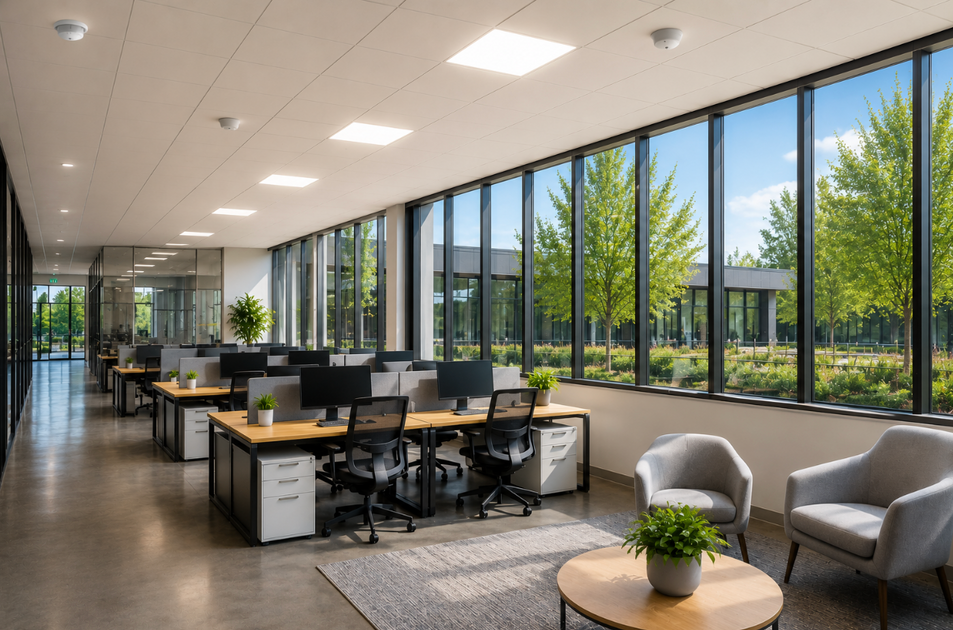
Walk into most modern commercial or industrial buildings today, and chances are you’ll encounter some form of automated lighting control. In a warehouse, lights illuminate the moment someone enters an aisle. In office spaces, fixtures dim gradually as natural sunlight fills the room. Conference room lighting shuts off automatically after employees leave, helping reduce unnecessary energy usage without anyone needing to think twice about it.
That’s not just convenience at work. It’s smart energy management.
As energy costs continue climbing and commercial buildings face stricter efficiency standards, occupancy sensors and daylight sensors have become essential components of modern lighting systems. Beyond reducing energy consumption, these technologies help improve user experience, extend fixture lifespan, and support compliance with energy codes and sustainability initiatives.
Still, there’s a surprising amount of confusion surrounding occupancy daylight sensors, especially when it comes to selecting the right technology for industrial and commercial spaces. PIR? Ultrasonic? Dual technology? Daylight harvesting? Occupancy vs vacancy sensor controls? It can feel like alphabet soup if you’re not working with lighting systems every day.
This guide breaks it all down in practical terms, covering the different types of occupancy sensors, how daylight sensors work, where each technology performs best, and what businesses should consider before installation.
Key Takeaways
- Occupancy sensors automatically control lighting based on movement and room usage, helping reduce unnecessary energy usage in buildings.
- Daylight sensors adjust artificial lighting levels based on available natural daylight, improving energy efficiency and supporting daylight harvesting strategies.
- Choosing the right sensor technology depends heavily on the application, ceiling height, expected environments, sensor coverage requirements, and building layout.
What Are Occupancy Sensors?
Occupancy sensors are automated devices designed to detect the presence of people within a space and control lighting accordingly. In commercial settings, these systems are typically used to turn lights on, dim fixtures, or switch lights off when an area becomes unoccupied.
At their core, occupancy detectors help eliminate one of the biggest sources of wasted electricity in commercial buildings: lights being left on in empty rooms.
In industrial and commercial facilities, lighting occupancy sensors are commonly installed in:
- Warehouses
- Distribution centers
- Industrial manufacturing plants
- Restrooms
- Offices
- Conference rooms
- Hallways
- Stairwells
- Parking garages
- Storage areas
Unlike traditional switches that rely entirely on manual operation, occupancy sensor systems automate the process using advanced sensor technology.
Most modern occupancy sensors integrate directly into broader digital lighting management platforms, allowing facility managers to monitor energy usage, scheduling, and system performance across entire buildings.
And honestly, that’s where the real value starts showing up. The bigger the building, the more costly wasted lighting becomes.
How Do Occupancy Sensors Work?
An occupancy sensor works by identifying movement or presence within a designated area. When movement is detected, the system signals connected light fixtures to turn on or remain on. Once the space becomes vacant for a preset period, the lights automatically switch off or dim.
Different sensors achieve this detection in different ways, which is why selecting the right technology matters so much.
Several factors influence sensor performance, including:
- Mounting height
- Room layout
- Obstructions
- Operating temperature
- Ceiling height
- Fixture spacing
- Expected environments
- Required sensor coverage
A pir motion sensor, for example, behaves very differently in a warehouse than it does in a private office.
That’s why industrial and commercial lighting applications require a more strategic approach than residential systems.
Types of Occupancy Sensors
Understanding the types of occupancy sensors available is critical when designing efficient lighting control systems.
Each technology has strengths, limitations, and ideal applications.
Passive Infrared (PIR) Sensors
Passive infrared sensors are among the most common occupancy sensor technologies used in commercial lighting.
A PIR sensor detects heat signatures emitted by people moving within its coverage area. Specifically, passive infrared pir technology senses changes in infrared radiation as occupants move through a space.
Because passive infrared sensors rely on line-of-sight detection, they perform best in open areas with clear visibility.
Typical applications include:
- Private offices
- Conference rooms
- Classrooms
- Open warehouse aisles
- Storage spaces
A pir motion sensor is often favored because it’s reliable, energy efficient, and relatively affordable.
However, PIR systems can struggle in spaces where occupants remain still for long periods. For example, someone quietly working at a desk may not generate enough motion for continuous detection.
Ultrasonic Sensors
Unlike passive infrared systems, ultrasonic sensors emit high-frequency sound waves that bounce throughout a room.
When movement disrupts those sound patterns, the sensor detects occupancy.
Ultrasonic systems excel in areas with partitions, corners, or obstructions because they don’t rely strictly on line-of-sight detection.
These sensors are commonly used in:
- Restrooms
- Open offices
- Hallways
- Break rooms
One tradeoff? Ultrasonic systems can occasionally produce false triggers because they’re extremely sensitive to motion.
Dual Technology Sensors
A dual technology sensor combines passive infrared and ultrasonic technologies into a single system.
In most cases, both technologies must confirm occupancy before lights activate or remain on. This reduces false triggers while improving detection accuracy.
For larger commercial space applications, dual technology systems often provide the best balance of reliability and energy savings.
They’re especially useful in:
- Warehouses
- Large conference rooms
- Manufacturing facilities
- Training centers
- Multi-use commercial environments
When paired with advanced digital lighting management systems, these sensors can dramatically improve overall building efficiency.
Occupancy vs Vacancy Sensor: What’s the Difference?
The conversation around occupancy vs vacancy sensor controls comes up constantly in commercial lighting projects.
And yes, there’s a meaningful difference.
Occupancy sensors automatically turn lights on when motion is detected and automatically turn them off after the space is vacant. This approach prioritizes convenience and automation.
A vacancy sensor requires users to manually turn lights on, but automatically switches them off after the room empties.
Vacancy controls are often preferred in spaces where unnecessary activations could become problematic, such as private offices or conference rooms with windows facing busy hallways.
From an energy efficiency perspective, vacancy sensors can sometimes outperform fully automated occupancy systems because lights only activate intentionally.
The right choice depends heavily on building usage patterns, occupant behavior, and overall lighting control goals.
What Are Daylight Sensors?
While occupancy sensors focus on human presence, daylight sensors respond to available natural light.
A daylight sensor measures ambient daylight levels within a space and adjusts artificial lighting accordingly.
This process, commonly called daylight harvesting, allows facilities to reduce electrical lighting output whenever sufficient daylight is available.
For commercial buildings with skylights, glass curtain walls, large office windows, or open industrial spaces, daylight harvesting can significantly reduce energy consumption.
Instead of running lights at full output all day long, the system dynamically adjusts lighting levels based on changing daylight conditions.
That means less wasted energy and more balanced indoor lighting conditions.
How Daylight Harvesting Works
Daylight harvesting systems continuously monitor light levels using integrated daylight sensors.
When sunlight increases, the system dims connected fixtures. When daylight decreases due to weather or time of day, artificial lighting gradually increases.
The transition is typically seamless when properly configured.
In industrial and commercial applications, daylight harvesting often works alongside occupancy daylight sensors to create layered lighting control strategies.
For example:
- Occupancy sensors determine whether a space is in use
- Daylight sensors determine how much artificial light is actually needed
Together, they optimize lighting performance while minimizing energy usage.
Choosing the Right Occupancy Daylight Sensors for Commercial Spaces
Not all sensors can handle the same job. Choosing the wrong system can lead to dead zones, nuisance shutoffs, poor user experience, or inconsistent lighting performance.
Several considerations should guide sensor selection.
Ceiling Height Matters
High ceilings dramatically impact detection performance.
In warehouses or manufacturing plants with elevated mounting heights, standard sensors may struggle to detect small movements below.
In these environments, high bay lens configurations are often necessary to maintain proper sensor coverage.
Mounting Style
Different facilities require different mounting approaches.
Common options include surface mount installations, fixture-integrated sensors, wall-mounted sensors, and ceiling tile mounted systems.
Large commercial buildings frequently use ceiling tile mounted occupancy detectors for open office layouts.
Environmental Conditions
Expected environments play a major role in sensor performance.
For example, dusty manufacturing facilities, cold storage environments, high-humidity warehouses, or outdoor loading docks can all create unique operational challenges.
Always review operating temperature ratings, enclosure protection, and product certifications before installation.
Industrial-grade sensors often undergo thorough testing to ensure long-term reliability under demanding conditions.
Why Commercial Buildings Use Smart Lighting Controls
There’s a reason lighting control systems have become standard in modern commercial facilities. Here are a few of the key factors why smart lighting controls are so popular in commercial and industrial spaces.
Reduced Energy Consumption
Lighting remains one of the largest operational expenses in commercial buildings.
Automated sensors help reduce unnecessary energy consumption by ensuring lights only operate when needed.
This directly lowers utility costs while supporting sustainability initiatives.
Improved Energy Efficiency
Commercial energy codes increasingly require advanced lighting control measures.
Occupancy daylight sensors help buildings meet modern efficiency standards while improving overall energy efficiency.
Many utility rebate programs also require DLC listed products or other recognized product certifications.
Extended Fixture Lifespan
Reducing unnecessary operating hours helps preserve light fixtures and light bulbs.
That means fewer maintenance calls, lower replacement costs, and longer system life overall.
Better User Experience
Nobody wants to walk into a dark warehouse aisle or manually manage lighting across a massive facility.
Smart sensors improve convenience while creating more consistent lighting environments.
And when systems are properly configured, occupants barely notice the automation at all.
That’s usually the sign of a well-designed system.
Integrating Sensors Into Modern Lighting Systems
Today’s advanced lighting systems go far beyond simple on/off switching.
Many facilities now integrate occupancy daylight sensors into centralized digital lighting management platforms capable of:
- Real-time monitoring
- Scheduling
- Remote configuration
- Zone management
- Utility reporting
- Predictive maintenance
- Automated dimming
These systems help facility managers gain deeper visibility into overall energy usage while simplifying operational control across large buildings.
In other words, lighting is becoming smarter, more connected, and far more data-driven than it was even a decade ago.
Frequently Asked Questions
What is an occupancy sensor?
An occupancy sensor detects movement or presence in a space and automatically controls lighting based on occupancy.
What is the difference between an occupancy sensor and a vacancy sensor?
Occupancy sensors automatically turn lights on and off, while vacancy sensors require manual-on operation but automatically switch lights off when the space is empty.
What are the main types of occupancy sensors?
The most common types of occupancy sensors are PIR sensors, ultrasonic sensors, and dual technology sensors.
How do daylight sensors work?
Daylight sensors measure available natural daylight and adjust artificial lighting levels automatically.
Where are occupancy sensors commonly used?
Occupancy sensors are commonly used in warehouses, offices, manufacturing facilities, conference rooms, and parking garages.
Do occupancy sensors help reduce energy costs?
Yes. Occupancy sensors help reduce energy consumption and improve overall energy efficiency by preventing unnecessary lighting usage.
Final Thoughts
For industrial and commercial facilities looking to improve energy efficiency, reduce operational costs, and modernize lighting infrastructure, occupancy sensors and daylight sensors are no longer optional upgrades. They’ve become foundational tools for smarter building management.
The key is choosing the right combination of sensor technology, mounting strategy, and lighting control design for your specific environment.
A pir motion sensor may work perfectly in one space and perform poorly in another. A daylight sensor can dramatically reduce energy usage in sunlit facilities but offer minimal benefit in enclosed environments. And understanding the difference between occupancy vs vacancy sensor systems can have a surprisingly large impact on long-term energy savings.
At the end of the day, successful commercial lighting design isn’t just about installing fixtures. It’s about creating intelligent systems that respond to how buildings are actually used.
That’s where thoughtfully selected occupancy daylight sensors make all the difference.