197. Cool White vs Daylight: Which LED Color Temperature Is Best?
By Dani Thomason • Jul 06, 2026
When shopping for LED lighting, you'll quickly notice that not all white light looks the same. Some fixtures produce a warm, inviting glow, while others emit a crisp, bright illumination that can feel sterile. Two of the most common options you'll encounter for commercial and industrial spaces are cool white and daylight, but deciding between them isn't always as straightforward as it seems.
The difference goes far beyond appearance. The color temperature you choose can affect productivity, visibility, comfort, and even how accurately colors appear within a space. Whether you're upgrading a warehouse, office, retail store, or another commercial facility, selecting the right lighting helps create an environment that supports both employees and customers.
So, when comparing cool white vs daylight, which option is best?
The answer depends on how the space is used, the level of detail required, and the atmosphere you're trying to create. In this guide, we'll break down the differences between cool white, warm white, and daylight to help you determine which option is best for your next project.
Key Takeaways
- Cool white vs daylight isn't about which option is brighter, it's about selecting the right color temperature for your application.
- Warm white creates a softer, more inviting atmosphere, while cool white offers a clean, balanced appearance.
- Daylight provides the brightest, crispest white light and closely resembles natural sunlight.
- Commercial and industrial facilities often benefit from cooler lighting because it improves visibility and supports productivity.
Understanding Color Temperature
Before comparing cool white vs daylight, it's important to understand what color temperature actually means.
Despite its name, color temperature doesn't refer to how hot a light bulb becomes. Instead, it describes the appearance of the light produced by a fixture.
This measurement is expressed in Kelvin (K), and each color temperature value corresponds to a different appearance along the white light spectrum.
As the Kelvin rating increases, the appearance of the light changes. For example, lower Kelvin ratings produce warmer, yellow-toned illumination, mid-range Kelvin ratings create balanced, neutral lighting, and higher Kelvin ratings produce crisp, bluish white light that resembles natural daylight.
Although many people associate brighter lighting with higher Kelvin ratings, it's important to remember that brightness and temperature are two completely different measurements. Two fixtures can produce the same amount of lumens while offering dramatically different light appearance simply because they have different color temperature ratings.
Understanding this distinction makes it much easier to select lighting that complements the intended purpose of a space.
What Is Warm White Light?
Warm white typically falls between 2700K and 3000K on the Kelvin scale.
This range creates a soft, inviting glow that's similar to the familiar illumination produced by a traditional incandescent bulb.
Many homeowners prefer warm white lighting because it creates a comfortable, relaxing atmosphere. Hotels, restaurants, hospitality spaces, and residential environments also frequently use warm white LED bulbs to make interiors feel welcoming.
While warm white light excels in comfort-focused environments, it generally isn't the first choice for industrial workspaces where maximum visibility is required.
What Is Soft White Light?
Many people use soft white and warm white interchangeably, but they're not always identical.
Generally speaking, soft white falls within the same lower Kelvin range as warm white, producing gentle illumination that's easy on the eyes.
You'll commonly find soft white used in reception areas, hotels, and restaurants. Because soft white minimizes harsh shadows and glare, it's often selected for areas where comfort matters more than precision.
For businesses looking to create a welcoming first impression, soft white light remains one of the most popular options.
What Is Cool White Light?
Moving higher on the Kelvin scale brings us to cool white lighting.
Typically ranging between 4000K and 4500K, cool white creates a clean, crisp appearance without appearing overly blue.
This balanced white light has become one of the most common choices for commercial buildings because it offers excellent visibility while remaining comfortable for employees working long shifts.
Many offices, healthcare facilities, educational institutions, and commercial buildings choose cool white LEDs because they provide a modern appearance without the clinical feel sometimes associated with higher Kelvin ratings.
For many businesses, cool white represents the "sweet spot" between comfort and performance.
What Is Daylight Lighting?
Daylight sits at the cooler end of the color temperature spectrum, generally ranging from 5000K to 6500K.
As its name suggests, daylight closely mimics the appearance of natural light during the middle of the day.
Unlike warm white or soft white, daylight lighting produces a noticeably cooler appearance with subtle hints of blue light.
The result is crisp illumination that maximizes contrast and makes fine details easier to see.
Because of these characteristics, daylight LEDs are commonly used in:
- Warehouses
- Manufacturing facilities
- Distribution centers
- Automotive service bays
- Workshops
- Laboratories
- Large commercial facilities
Many industrial businesses also install daylight bulbs in inspection areas where accurate visibility is essential.
When paired with high-quality fixtures, daylight provides exceptional clarity while supporting employee productivity throughout the workday.
Cool White vs Daylight: What's the Difference?
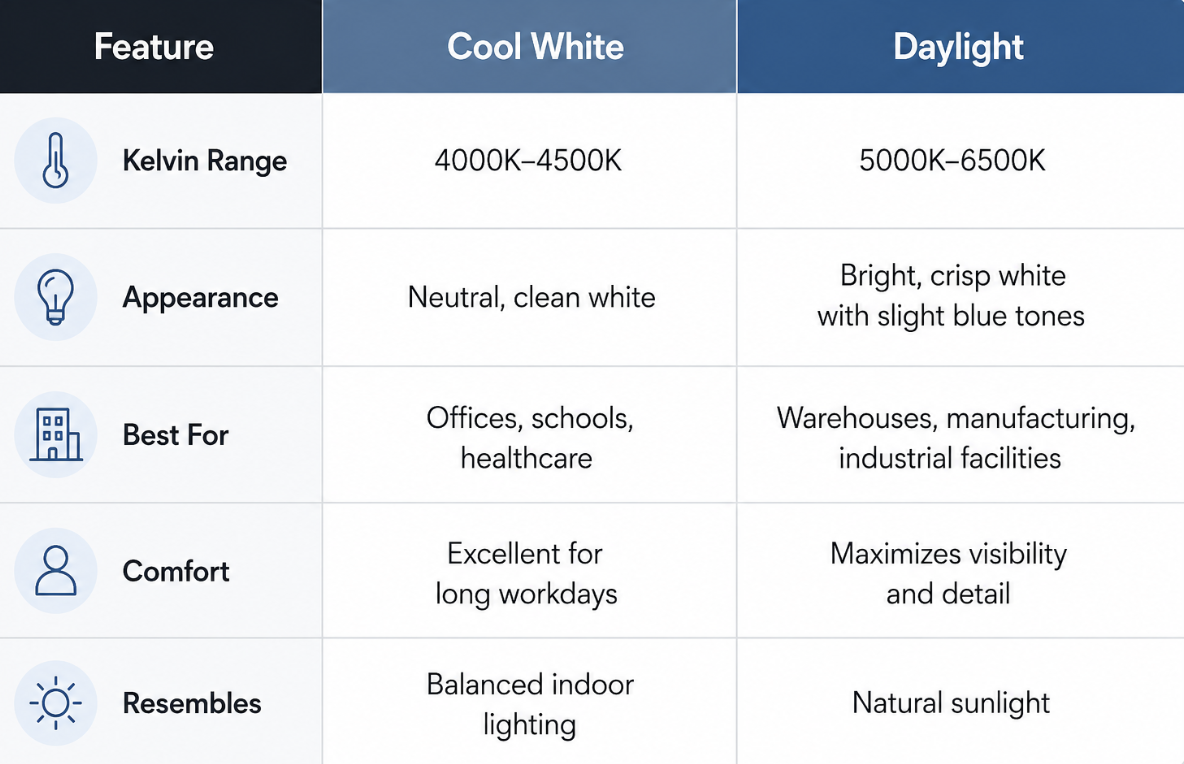
At first glance, cool white and daylight may seem similar. Both produce crisp white light, both are significantly cooler than warm white, and both are widely used in commercial environments.
However, there are several important distinctions.
The biggest difference comes down to application.
If your priority is creating a comfortable workspace with balanced lighting, cool white is often the better option.
If maximum visibility, precision, and brightness are the goal, daylight typically provides better performance.
Cool White vs Daylight for Commercial and Industrial Lighting
Commercial and industrial spaces each have unique lighting requirements.
Although both often use cooler color temperature options, the ideal choice depends on the activities taking place inside the building.
Commercial Lighting
Commercial buildings generally prioritize employee comfort alongside productivity.
For offices, retail environments, and healthcare facilities, cool white often provides the ideal balance.
Benefits include:
- Comfortable working conditions
- Professional appearance
- Balanced white light
- Reduced visual fatigue
- Attractive presentation for customers
Because these environments involve extended occupancy, an overly cool light color may feel sterile over time.
Industrial Lighting
Industrial environments have different priorities.
Manufacturing plants, warehouses, and logistics facilities require lighting that improves precision, safety, and efficiency.
In these settings, daylight often becomes the preferred choice because its higher temperature provides exceptional clarity.
Combined with high-quality LED lighting, daylight helps workers:
- Read labels more easily
- Improve inventory accuracy
- Identify hazards
- Perform quality inspections
- Increase overall productivity
Outdoor Lighting: Which Color Temperature Works Best?
Selecting the right outdoor LED lighting requires balancing visibility, security, and aesthetics.
For decorative applications, warmer lighting often creates a welcoming appearance.
For example, a garden light installed along walkways or landscaping may benefit from warm white because it complements natural surroundings without feeling overly bright.
Security lighting is different.
Parking lots, loading docks, commercial campuses, and building exteriors often perform better with daylight because it increases contrast and improves nighttime visibility.
Many businesses also install daylight bulbs in perimeter fixtures to enhance surveillance camera performance.
Ultimately, the best choice depends on the purpose of the installation.
Common Mistakes When Choosing LED Lighting
Even experienced facility managers occasionally choose the wrong color temperature for a project. Here are several mistakes worth avoiding.
Choosing Based on Appearance Alone
Just because a fixture looks bright doesn't mean it's appropriate for the application. Always evaluate both function and comfort before selecting a white bulb.
Ignoring Existing Lighting
Mixing dramatically different color temperature values throughout a facility can create inconsistent illumination that feels distracting. Whenever possible, maintain consistency within the same workspace.
Focusing Only on Color Temperature
While color temperature is important, it's only one piece of the puzzle.
Fixture quality, optical distribution, energy efficiency, and brightness all contribute to overall lighting performance.
Using Residential Products in Commercial Spaces
Commercial and industrial facilities require durable fixtures built for demanding environments.
Choosing commercial-grade LED lighting helps improve reliability, reduce maintenance, and maximize long-term value.
Frequently Asked Questions
Is cool white or daylight brighter?
Not necessarily. Brightness is measured in lumens, while color temperature describes the appearance of the light. A cool white fixture and a daylight fixture can produce the same lumen output.
Which is better for offices: cool white or daylight?
Most offices perform well with cool white lighting between 4000K and 4500K because it creates a clean, comfortable environment without appearing overly harsh.
Is daylight too bright for indoor use?
No, daylight is not too bright for indoor use. Daylight works exceptionally well in warehouses, manufacturing facilities, workshops, and other environments where visibility and precision are priorities.
Is warm white better than cool white?
Neither option is universally better. Warm white creates a comfortable atmosphere, while cool white supports productivity and everyday commercial applications.
Final Thoughts
When comparing cool white vs daylight, there isn't a one-size-fits-all answer. The right choice depends on your environment, the tasks being performed, and the experience you want to create.
Warm white remains the preferred option for hospitality and comfort-focused spaces, while cool white delivers a balanced solution for offices, healthcare facilities, and commercial buildings. For warehouses, manufacturing plants, and other industrial environments where precision and visibility are essential, daylight often provides the greatest benefits.
Understanding how color temperature affects light appearance, productivity, and overall performance allows you to make a more informed investment in your lighting system.
At OEO Energy Solutions, we help businesses select high-performance LED lighting solutions designed for their specific applications. Whether you're upgrading a commercial office, outfitting a warehouse, improving outdoor lighting, or replacing outdated LED fixtures and light bulbs, our team can help you choose the ideal color temperature and fixture to maximize efficiency, enhance visibility, and deliver long-lasting performance.