189. Smarter Perimeter Lighting: How Facilities Improve Security & Reduce Energy Costs
By Dani Thomason • May 22, 2026
When people think about security upgrades for commercial or industrial properties, their minds usually jump straight to surveillance cameras, gates, access control systems, or perimeter fencing.
Lighting, oddly enough, often becomes an afterthought. Which is a very big mistake.
A poorly lit exterior creates more than just visual discomfort. It introduces safety concerns, reduces visibility, increases liability risks, and leaves properties vulnerable to unauthorized activity. On the flip side, smart perimeter lighting can dramatically improve security while also lowering long-term energy costs.
And today’s facilities have far more options than simply mounting a few flood light fixtures around the building and calling it done.
Modern led perimeter lighting systems are becoming increasingly strategic, blending advanced controls, efficient led technology, optimized fixture placement, and carefully planned perimeter lighting design to create safer, smarter, and more energy-conscious commercial environments.
The result? Better illumination, fewer dark spots, lower maintenance demands, and significantly improved operational efficiency.
In this guide, we’ll break down how commercial perimeter lighting works, why fixture layout matters so much, and how businesses can improve both security and energy performance through smarter exterior lighting strategies.
Key Takeaways
- Smart perimeter lighting improves security, visibility, and energy efficiency across commercial and industrial properties.
- Modern led perimeter lighting systems reduce maintenance costs while delivering more consistent illumination.
- Effective perimeter lighting design focuses on fixture placement, glare control, light distribution, and minimizing unnecessary energy usage.
Why Perimeter Lighting Matters More Than Ever
Commercial properties don’t stop operating when the sun goes down.
Warehouses continue shipping orders. Manufacturing facilities run overnight shifts. Distribution centers stay active around the clock. Parking lots, loading docks, pathways, and outdoor space areas all require reliable illumination to maintain safety and visibility after dark.
That’s where perimeter lighting becomes essential.
A well-designed perimeter lighting system helps:
- Improve site security
- Reduce hidden areas around buildings
- Increase employee safety
- Improve camera visibility
- Deter trespassing
- Support operational efficiency
- Reduce liability risks
And frankly, it also shapes how people perceive the property itself.
Dimly lit exteriors often feel neglected or unsafe, while balanced outdoor perimeter lighting creates a cleaner, more professional appearance across commercial exteriors.
The Shift Toward LED Perimeter Lighting
Not long ago, many perimeter security lighting systems relied heavily on older HID fixtures or metal halide lamps.
The problem? Those systems consumed large amounts of energy, required frequent maintenance, and often created inconsistent light output across the property perimeter.
Modern led perimeter lighting changes the equation entirely.
LED fixtures provide better energy efficiency, longer operational lifespan, a better control integration, and more consistent brightness within a given space. For large commercial sites, those improvements can significantly reduce operational costs over time.
And because LED lighting fixtures perform exceptionally well in cold weather and outdoor environments, it’s become one of the most reliable lighting solutions for industrial and commercial perimeter applications.
Understanding Perimeter Lighting Design
Good perimeter lighting design involves far more than simply maximizing brightness.
Actually, too much uncontrolled light can create its own set of problems.
Overly intense fixtures may produce LED glare, visibility issues, uneven illumination, or excessive light pollution that negatively affects neighboring properties and surrounding outdoor space areas.
A smarter approach focuses on balance.
Effective commercial perimeter lighting should provide:
- Adequate illumination
- Clear visibility
- Reduced glare
- Consistent coverage
- Minimal dark spots
- Efficient energy usage
- Improved camera performance
The goal is controlled visibility, not overwhelming brightness.
Common Fixtures Used in Commercial Perimeter Lighting
Different facilities require different fixture strategies depending on the property layout, mounting conditions, and security goals.
Wall pack fixtures remain one of the most common solutions for commercial perimeter lighting because they provide reliable illumination directly along building exteriors. Mounted strategically around entrances, pathways, and loading areas, these fixtures help maintain visibility close to the structure itself.
For larger outdoor perimeter applications, flood light fixtures are often used to illuminate open areas, perimeter fence lines, storage yards, and parking zones. These fixtures provide broader coverage and higher output where greater visibility is required.
Many facilities also combine led fixtures with architectural lighting elements to improve both functionality and visual appeal across commercial exteriors.
Avoiding Common Perimeter Lighting Mistakes
One of the biggest misconceptions in security lighting is that brighter automatically means safer for your outdoor LED lighting.
That’s not always true.
Poorly positioned lighting fixtures can create harsh shadows, excessive glare, and visibility problems that actually make surveillance more difficult. In some cases, bright center light concentrations surrounded by darker edges create severe contrast issues that reduce visibility instead of improving it.
This becomes especially problematic around perimeter fence areas or loading docks where consistent illumination matters most.
Other common mistakes include:
- Uneven fixture spacing
- Incorrect mounting heights
- Overlighting certain zones
- Ignoring color temperature consistency
- Failing to account for camera visibility
- Creating unnecessary light pollution
A successful perimeter lighting design requires careful planning, not just higher wattage.
The Role of Color Temperature in Security Lighting
Color temperature plays a surprisingly important role in perimeter security lighting.
Cooler led light output typically improves visibility and camera clarity better than older yellow-toned lighting systems. Neutral white color temperatures often create the best balance between visual comfort and security performance.
When different fixtures produce varying color temperatures, the property can develop noticeable color imbalances that make the lighting system appear disjointed or uneven.
For commercial and industrial facilities, maintaining consistent illumination across the perimeter creates a more professional appearance while supporting better nighttime visibility.
Smart Controls & Energy Savings
One of the biggest advantages of modern led lighting is the ability to integrate advanced controls directly into the lighting system.
Instead of running fixtures at full brightness all night long, facilities can now use:
- Motion-based activation
- Scheduling systems
- Dimming controls
- Adaptive lighting zones
- Occupancy sensors
- Photocells
- Dimmer switch controls
This allows commercial properties to dramatically reduce unnecessary energy consumption without sacrificing security.
For example, a facility may maintain lower baseline illumination overnight while temporarily increasing brightness when motion is detected near entrances or perimeter fence areas.
That flexibility helps reduce energy costs while still maintaining effective security lighting performance.
Reducing Dark Spots & Improving Visibility
Dark spots are one of the biggest weaknesses in perimeter security lighting.
Poorly illuminated corners, pathways, storage yards, or loading zones create opportunities for trespassing while reducing camera effectiveness and employee safety.
Smart fixture placement helps eliminate those gaps.
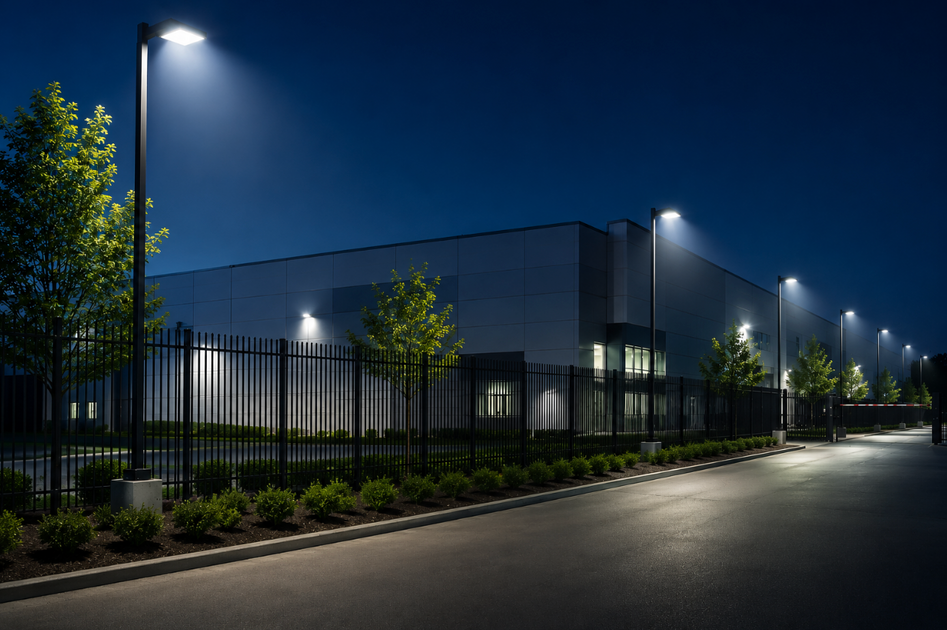
The best perimeter lighting layouts create overlapping illumination patterns that maintain visibility without creating excessive brightness or center table glare-style hot spots across the property.
Overly aggressive fixtures can create visibility problems by forcing the eye to constantly adjust between bright and dark areas. That’s why balanced illumination is so important.
LED Technology & Long-Term Maintenance Savings
Maintenance costs are often overlooked during perimeter lighting upgrades.
But for large industrial properties, those costs can add up fast.
Replacing outdated fixtures across large perimeters frequently requires lift equipment, electrical labor, and operational downtime. Older systems also tend to experience more frequent lamp failures and inconsistent performance over time.
Modern led technology significantly reduces those maintenance demands.
High-quality LED lights can operate for tens of thousands of hours before noticeable lumen depreciation occurs. That longer LED lifespan translates directly into fewer replacements, lower labor costs, and more reliable perimeter illumination overall.
For facilities operating around the clock, reduced maintenance interruptions alone can justify the upgrade investment.
Architectural Lighting & Exterior Aesthetics
Security isn’t the only purpose of perimeter lighting.
Commercial exteriors also contribute to branding, professionalism, and overall property perception.
Architectural lighting techniques such as cove lighting, accent lighting, linear recessed lighting, and other outdoor LED fixtures can enhance architectural features while still supporting security goals.
This is especially common in commercial offices, hospitality properties, mixed-use developments, and retail facilities.
A thoughtfully designed lighting system improves both functionality and aesthetic appeal without compromising energy efficiency.
That balance between performance and visual appeal has become increasingly important in modern commercial lighting design.
Why Fixture Placement Matters
Even the best LED fixtures can underperform if they’re installed incorrectly.
Fixture spacing, mounting height, aiming angles, and beam patterns all influence overall perimeter lighting performance.
Improper placement can create:
- Excessive glare
- Uneven illumination
- Blind spots
- Aspect ratio flaws
- Harsh shadowing
- Overlit zones
Experienced lighting designers focus heavily on fixture positioning to create smooth, consistent illumination across the entire perimeter.
This is particularly important in large industrial sites where outdoor perimeter coverage may span multiple buildings, storage yards, and access roads.
Commercial Perimeter Lighting for Industrial Facilities
Industrial facilities often require more robust perimeter security lighting strategies than smaller commercial properties.
Warehouses, logistics centers, manufacturing plants, and utility facilities typically operate across larger footprints with higher security demands.
These environments often combine multiple fixture types, including wall pack fixtures, flood light systems, pole-mounted perimeter light installations, or even parking lot light fixtures.
The lighting system may also integrate with cameras, security systems, and automated controls to create layered protection across the property perimeter.
And because many industrial facilities operate overnight shifts, maintaining consistent visibility becomes even more important for employee safety and operational continuity.
Final Thoughts
A smarter perimeter lighting strategy does far more than illuminate the outside of a building.
The right system improves visibility, strengthens security, reduces energy usage, supports surveillance performance, and creates a safer environment for employees, visitors, and operations after dark.
Modern led perimeter lighting gives commercial and industrial facilities the ability to achieve all of those goals simultaneously while lowering long-term maintenance demands and operational costs.
From wall pack fixtures and flood light systems to advanced controls and carefully planned perimeter lighting design, today’s lighting solutions offer far more flexibility and efficiency than traditional systems ever could.
But successful commercial perimeter lighting isn’t just about installing brighter fixtures. It’s about creating balanced illumination, eliminating dark spots, minimizing glare, and designing a lighting system that actually supports how the property operates day after day.